


In my last post, I compared AI security to traffic systems: policies without runtime enforcement are like traffic laws without speed cameras. Drivers may know the rules, but without real-time controls, chaos eventually wins.
The same is true for agentic AI. Guidance alone isn’t enough. Enforcement at runtime without depending on SDK is what turns policy into productivity.
But here’s the part we don’t talk about enough: runtime enforcement isn’t just about safety. It’s about business value.
When security teams control policies directly — without waiting for developer cycles — enterprises don’t just reduce risk. They save money, move faster, and realize the productivity gains of agentic AI sooner. That’s real ROI.
Throughout this article, I will use example values to illustrate the ROI of runtime enforcement without SDK. But every organization’s numbers are different. That’s why we built an ROI calculator — so you can plug in your own assumptions and model the savings directly for your environment.
The Hidden Cost of Developer-Dependent Security
Don’t get me wrong — developers need SDKs while building applications. They use them to detect, block, and wire in security checks as part of development. But once an application is live in production, the center of gravity shifts. Monitoring and policy enforcement become the security team’s job.
And here’s the catch: policies don’t sit still. Threats evolve, compliance requirements change, customer expectations shift. Security is never “set it and forget it.” Policies need constant adjustment to stay relevant.
Yet in most organizations, every policy update loops back through the developer cycle to modify the code, re-test and QA, and push a new release
On paper, that looks like a normal dev process. But in reality, it’s a business drag. It means:
- Slow → Weeks of delay every time a new rule is needed
- Costly → Dozens of developer hours per update
- Inconsistent → Different teams handle enforcement differently, creating gaps
This isn’t just inefficiency. It’s opportunity cost. Time that developers could spend building revenue-driving features gets sunk into plumbing. Time that the business could spend realizing agent-driven productivity gains gets lost in translation.
The biggest missed value isn’t in the costs you save — it’s in the capacity and speed you gain. Every delay in policy enforcement is a delay in adoption, which is a delay in value capture.
The ROI of Runtime Policy Enforcement without SDK
When we talk about security, it’s easy to frame the conversation in terms of risk avoidance. But the real story is about business value: how much faster you can move, how much developer time you save, and how much more capacity you unlock. Let’s break down the ROI — not in abstract terms, but in practical, per-agent numbers.
1. Policy Update Cost — Engineering Effort per Update
Every time a security policy changes — whether adding a new PII pattern, adjusting tool permissions, or modifying data access rules — developers have to:
- Modify the code
- Integrate or adjust SDKs
- Test the change
- Redeploy into production
Let’s assume this takes ~40 hours per update. In some organizations the process is lean, in others it requires coordinate across multiple functional groups or environments — meaning the effort can be much higher.
For our example, let’s assume 12 policy updates per year per agent (≈1 per month). That adds up to 480 hours annually. At a fully loaded developer cost of $100/hour (salary + benefits + overhead), that’s about $48K per agent per year.
One update per month is a conservative assumption. In reality, threat landscapes shift quickly — new attack patterns, new compliance requirements, new customer demands. Most enterprises will likely see more frequent policy changes.
👉 [In our ROI calculator, you can plug in your own assumptions for “hours per update”, “number of updates”, and the “developer’s hourly rate” so the savings reflect your environment.]
Bottom line: This is a project-based cost, tied directly to the number of policy changes.
2. Adoption Delays — Value Capture Delay
In this category, we measure the business value lost when policy enforcement is dependent on developer cycles. Every delay in adoption means the Agent ROI (Productivity Value) is pushed further into the future. Skyrelis helps remove that delay.
Each AI agent contributes measurable business value. It isn’t always easy to calculate this number, but it is the foundation of the AI agent ROI model. Every business leader deploying agentic AI should know their own agent productivity value. The exact number varies by use case: a support agent, a sales agent, and an R&D automation agent will all deliver different levels of impact.
For illustration, let’s assume an agent delivers $100K per year in productivity gains from automation or workflow acceleration. If deployment is delayed by just one quarter because policies are waiting on code changes, the business captures only $75K instead of $100K — leaving $25K in unrealized agent ROI.
👉 [In the ROI calculator, you can enter your own agent productivity value and the estimated time required to wire in the policy to see how delays translate directly into lost ROI.]
Bottom line: This is a business opportunity cost, not an engineering expense.
3. Developer Productivity Drag — Freeing Capacity
This is the ongoing time developers lose on “security plumbing” (SDK wiring, debugging, coordination with security) instead of building features.
Beyond the project work tied to individual policy updates, there’s another hidden cost: the day-to-day drag on developer productivity.
Even when no new policy is being rolled out, developers still spend time on “security plumbing”:
- Debugging integration issues
- Coordinating with security teams
- Maintaining enforcement logic across releases
- Wiring in and maintaining different policies across customers and user groups
Ask any developer, and they’ll tell you — this isn’t where they create the most impact. Every hour spent here is an hour not spent building features, improving performance, or accelerating innovation.
To put numbers on it: suppose one engineer overall cost is $200K (Salary + benefits + overhead). If ~10% of that engineer’s time is tied up in security plumbing, that’s about $20K per agent per year in lost productivity.
👉 [In the ROI calculator, you can enter your own values for % of developer time lost to plumbing and fully loaded annual cost per developer. This lets you adjust the drag to reflect your team’s reality.]
Bottom line: This is a recurring productivity drain, independent of the number of policy changes.
4. Risk Reduction — Lowering Exposure
We also need to measure the reduction in security incidents or compliance gaps when policies are consistently enforced at runtime.
Inconsistent enforcement isn’t just a nuisance; it’s a liability. If each app or agent enforces policies differently, gaps appear — and gaps invite incidents. The average breach today costs $4.5M. Even assuming runtime enforcement reduces that risk by just 1%, the savings average out to $45k per agent per year.
👉 [In the ROI calculator, you can adjust the % of the probability reduction to reflect your risk profile.]
Bottom line: This is a risk-adjusted savings that compounds as deployments scale.
Total ROI Per Agent
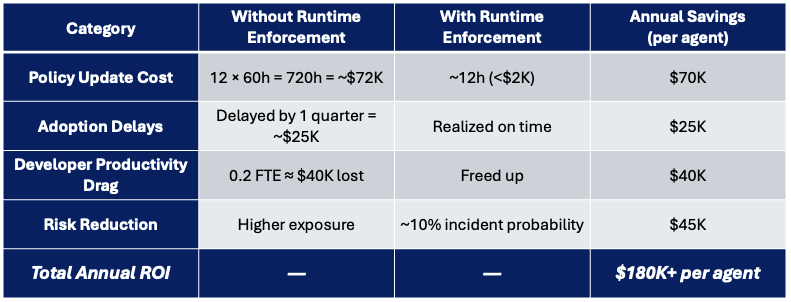
Why This Matters
When security teams own policy enforcement directly, the impact goes far beyond risk reduction.
- Developers are freed to focus on innovation, not endless plumbing.
- Productivity gains arrive faster, as agents move from pilot to production safely and at scale.
- Incidents decrease, and the ones that remain are easier to manage.
Security is no longer the brake pedal. It becomes the accelerator that allows agentic AI to deliver on its promise.
For most enterprises, adopting Skyrelis means hundreds of thousands in annualized ROI — from developer cycle savings, fewer incidents, and faster realization of AI-driven value.
This isn’t about fear. It’s about proving business value.
👉 [Want to see what this looks like for your team? Download the ROI Calculator and model the savings directly with your inputs.]
------
Reposted from https://medium.com/@jazlin/developers-arent-cisos-and-that-s-why-ai-needs-agentic-security-infrastructure-3bc0b69f1d29
Learn more at https://skyrelis.com/
.svg)


.svg)
